
Aysha
Hi, I'm Aysha, a Delhi University graduate currently pursuing a course in Digital Marketing. I'm passionate about learning and exploring the world of SEO, content writing, social media, and AI in digital marketing. Through my blogs, I aim to share useful information and insights in a simple and easy-to-understand way. I believe in learning new things and growing with the ever-changing digital world.
GEO vs SEO
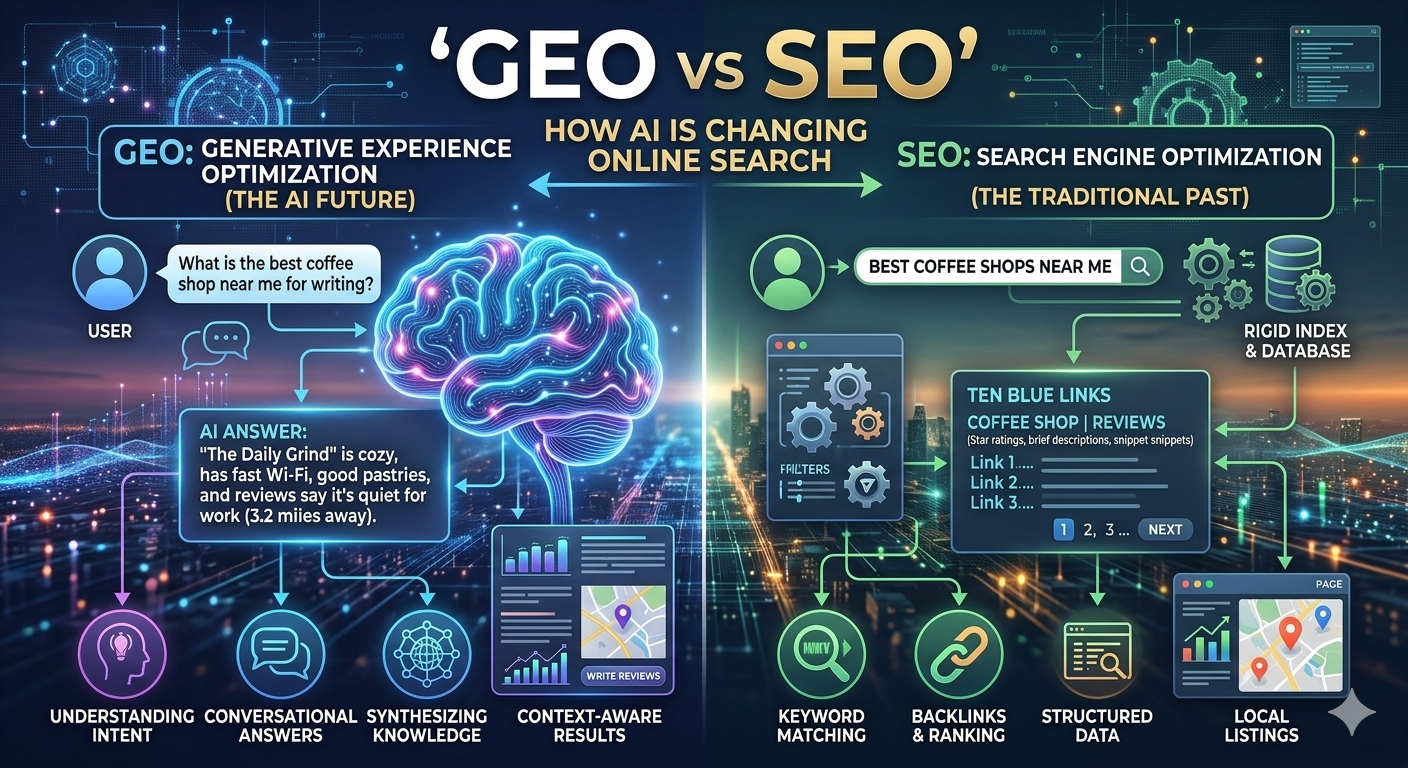
Table of Contents
GEO vs SEO: How AI Is Changing Online Search
Introduction
Have you ever searched for something on Google and noticed that AI gives you an answer before you even click on a website? This is one of the ways AI is changing how we search for information online.
Earlier, when we searched for something, we mostly saw a list of websites. We clicked on different links to find the information we needed. But now, AI-powered search tools can understand our questions and provide quick answers in a more conversational way.
This change has introduced a new term in digital marketing called GEO (Generative Engine Optimization).
We already know about SEO, but what exactly is GEO? How is it different from SEO? And why should digital marketers understand both?
Let’s explore it in a simple way.
What Is SEO?
SEO stands for Search Engine Optimization. It is the process of improving a website so that it can appear higher in search engine results.
For example, imagine you have a blog about digital marketing. When someone searches for “benefits of content marketing” on Google, you want your blog to appear among the relevant search results.
SEO helps you work towards that goal.
Some common SEO activities include:
Using relevant keywords in your content
Writing helpful and informative blogs
Improving website speed and mobile experience
Adding useful internal and external links
Optimizing page titles and meta descriptions
Building your website’s authority and trust
The main goal of SEO is to help people find your content through search engines.
What Is GEO?
GEO stands for Generative Engine Optimization. It focuses on making your content easier for AI-powered search and answer tools to understand and potentially use when generating answers.
For example, someone might ask an AI search tool, “Which digital marketing skills should a beginner learn?”
Instead of showing only a list of websites, the tool may generate an answer using information from different sources.
GEO focuses on making your content clear, useful, relevant, and trustworthy so that AI systems can understand it and may consider it when preparing answers.
Some ways to improve your content for GEO include:
Answering questions clearly and directly
Using simple language and meaningful headings
Providing accurate and useful information
Supporting claims with reliable sources
Showing your experience and knowledge of the topic
Keeping important information easy to understand
However, there is no guaranteed method to make an AI tool mention your website. Different tools use different systems to find and select information.
GEO vs SEO: What Is the Difference?
SEO and GEO have a similar purpose: helping people discover useful content online. However, they focus on different ways people may find that content.
| SEO | GEO |
|---|---|
| Focuses on visibility in search engine results | Focuses on visibility in AI-generated answers |
| Helps users discover pages through search results | Helps content become a possible source for AI answers |
| Uses keyword research, technical SEO, links, and useful content | Emphasizes clear answers, reliable information, context, and useful content |
| Often aims to bring users to a website from search results | May help users discover a brand through an AI-generated response |
| Commonly measured through rankings, clicks, and organic traffic | Can also be evaluated through AI mentions, citations, and referral traffic |
The important thing to remember is that GEO does not replace SEO. Both can work together as online search continues to change.
How Is AI Changing Online Search?
AI is making search more conversational and helping people find information in different ways.
Let’s understand some important changes.
1. People Can Ask Questions Naturally
Earlier, people often searched using short keywords like “best email marketing tools.”
Now, they may ask a complete question, such as “Which email marketing tool is best for a small business with a limited budget?”
AI-powered search tools can interpret these longer questions and provide answers based on the context.
This means that creating content that answers real questions is becoming increasingly important.
2. AI Can Give Quick Answers
AI-generated summaries can help users understand a topic without opening several websites.
For example, someone searching for “What is SEO?” may see a short explanation directly in the search experience.
For users, this can save time. For businesses and bloggers, it means they need to create content that offers genuine value, not just content that repeats basic information.
It is also important to remember that AI answers do not always remove the need to visit websites. People may still click through when they want more detail, examples, or reliable sources.
3. Search Is Becoming More Conversational
AI tools allow people to ask follow-up questions instead of starting a completely new search every time.
For example, a user may first ask, “What is content marketing?” and then ask, “How can a small business use it?”
This makes it useful for bloggers to explain topics clearly and cover related questions that readers may naturally have.
4. Brand Visibility Is More Than Rankings
Earlier, many businesses mainly focused on where their website appeared on Google.
Now, digital marketers may also want to understand whether their brand appears in relevant AI-generated answers.
For example, if an AI tool mentions a company while answering a question about digital marketing services, that can create another opportunity for people to discover the brand.
However, AI visibility can vary between tools and searches, so it should be treated as an additional marketing goal rather than a replacement for website traffic and search rankings.
Why Is GEO Important for Digital Marketers?
As AI-powered search becomes part of the online experience, digital marketers need to understand how people discover information.
GEO is worth learning about for several reasons.
It creates new opportunities for brand discovery. People may discover businesses through AI-generated answers, recommendations, and source links.
It encourages helpful content. Content that answers questions clearly and provides useful information can serve both readers and AI systems.
It supports brand credibility. Accurate information, relevant experience, and trustworthy sources can help build a brand’s reputation.
It helps marketers adapt. Learning about GEO allows digital marketers to explore new ways of measuring and improving online visibility.
GEO is still an evolving area, so marketers should focus on useful practices instead of expecting quick or guaranteed results.
How Can You Optimize Your Content for Both SEO and GEO?
The good news is that you do not always need two completely different content strategies. Many good SEO practices can also help make content easier for AI systems to understand.
Here are some practical tips.
1. Write Helpful Content for Real People
Before writing a blog, think about what your audience actually wants to know.
For example, if you are writing about social media marketing, explain how businesses can use social media, share practical tips, and include relatable examples.
Do not write only to add keywords. Focus on solving the reader’s problem.
2. Use Clear Headings
Divide your blog into sections with meaningful headings.
This helps readers find information quickly and makes the structure of your content easier to understand.
For example, instead of using a heading like “More Information,” use “How Does Email Marketing Help Small Businesses?”
3. Answer Questions Directly
If your heading asks a question, answer it clearly near the beginning of that section.
For example:
What is GEO?
GEO is the process of improving content so it can be understood and potentially referenced by AI-powered answer engines.
After giving a direct answer, explain the topic in more detail.
4. Use Reliable Information
Always try to share accurate information. When discussing statistics, research, or industry trends, use reliable sources and link to them where appropriate.
Avoid adding facts just to make your blog look more impressive.
Trustworthy content is valuable to readers, whether they discover it through a traditional search engine or an AI tool.
5. Keep Your Website Technically Healthy
Your website should load properly, work well on mobile devices, and allow search engines to access important pages.
Use descriptive page titles, relevant meta descriptions, clear URLs, and appropriate internal links.
These are useful SEO practices that support your website’s overall discoverability.
6. Show Your Experience and Knowledge
Do not simply repeat what every other website says.
Add examples, practical tips, explanations, and your own understanding of the topic. If you are writing a tutorial, explain the steps in a way that someone can actually follow.
This makes your content more useful and gives readers a reason to trust your website.
Will GEO Replace SEO in the Future?
No one can say exactly how online search will develop in the coming years, but GEO is better understood as an additional approach rather than a replacement for SEO.
Traditional search engines remain important, and websites still need good content, a healthy technical setup, and a useful experience for visitors.
At the same time, AI-powered search experiences are creating new ways for people to find information.
For digital marketers, the smarter approach is to understand both.
Instead of choosing between SEO and GEO, focus on creating content that is useful for people, easy to understand, technically accessible, and supported by reliable information.
These practices can help your content remain valuable as search technology continues to change.
Conclusion
AI is changing the way people search for information online. From quick answers to conversational search, people now have more ways to discover information, products, and brands.
SEO helps websites improve their visibility in search engine results, while GEO focuses on helping content become a possible source for AI-generated answers.
Both are important topics for anyone learning digital marketing today.
The best part is that you do not need to make your content complicated. Start with clear explanations, useful examples, relevant headings, and accurate information.
Remember, digital marketing keeps changing, so learning new things and adapting to these changes is an important part of growing in this field.
What Can You Do Next?
If you are learning digital marketing, try reviewing one of your existing blogs.
Check whether it answers the reader’s main question, uses clear headings, provides useful information, and includes reliable sources where needed.
You can also learn more about SEO, content writing, and AI-powered search to understand how these areas work together.
If you are learning digital marketing at Vidya Sarthi Institute, you can apply these ideas to your practical projects and experiment with improving your own blog content.
Keep learning, keep practising, and stay curious about the changes happening in digital marketing.
FAQs
What is the difference between GEO and SEO?
SEO focuses on improving a website’s visibility in search engine results, while GEO focuses on helping content become a possible source for AI-generated answers. Both help people discover useful information online.
What does GEO stand for in digital marketing?
GEO stands for Generative Engine Optimization. It involves improving content so AI-powered search and answer tools can understand it and potentially use it in their responses.
Is GEO replacing SEO?
No, GEO is not replacing SEO. Traditional search engines are still important, but AI-powered search is creating new ways for people to find information. Businesses can use both approaches together.