Table of Contents
1. The Landscape Shift: From Keywords to Answers
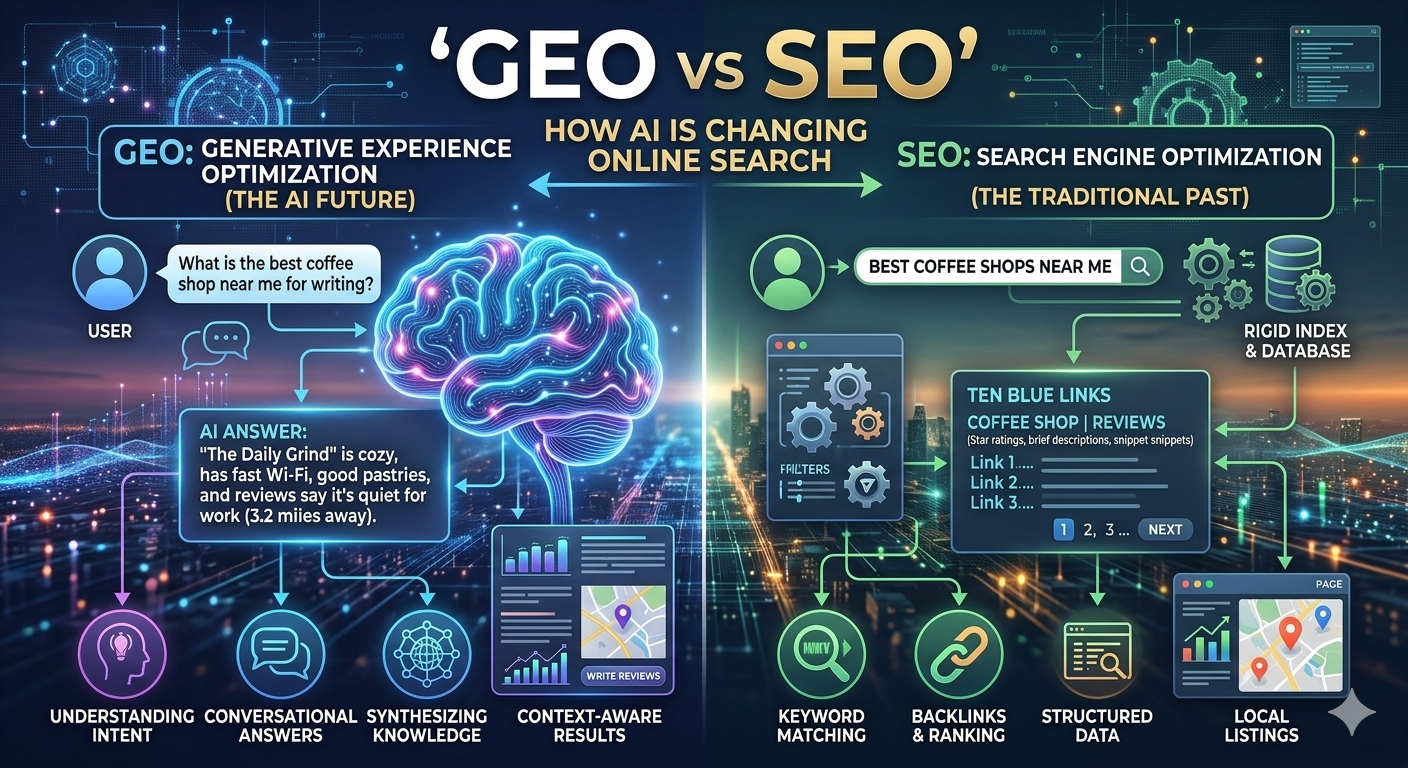
For decades, search engine optimization was built on a simple premise: type a query into a search box, hit enter, and browse through a page of blue links to find your answer. However, with the rapid rise of Large Language Models (LLMs) and tools like Google Gemini, Perplexity, and OpenAI ChatGPT Search, the fundamental nature of online discovery is transforming.
80%+
Queries Answered Directly In-Engine
Natural
Conversational Search Queries
GEO
Generative Citation Optimization
Users no longer just search with isolated key terms like "best digital marketing course". Instead, they ask complete questions: "How do I choose between SEO and GEO for my small business strategy in 2026?" AI engines extract, synthesize, and display complete synthesized summaries—citing direct references along the way.
2. What is Search Engine Optimization (SEO)?
Search Engine Optimization (SEO) is the practice of enhancing web content, technical architecture, and site authority so that search engine crawlers (like Googlebot) can index and rank your pages near the top of Search Engine Results Pages (SERPs) for target keywords.
3. What is Generative Engine Optimization (GEO)?
Generative Engine Optimization (GEO) is the emerging discipline of structuring and phrasing content so that artificial intelligence search models choose your brand, stats, quotes, and research as reliable source citations inside their generated AI answers.
"In GEO, success is measured not just by raw page clicks, but by how frequently and prominently your brand is recommended inside synthesized AI answers."
4. SEO vs GEO: Core Differences
Comparison Matrix| Feature | Traditional SEO | Generative GEO |
|---|---|---|
| Primary Target | Search engine crawlers & blue link algorithms | AI Generative Engines & Large Language Models |
| User Intent | Short, exact keywords (e.g. "best wireless mic") | Conversational, multi-step queries |
| Content Focus | Keyword density, heading tags, metadata, page speed | Direct answers, statistics, expert quotes, schema |
| Key Metric | SERP Rank position, Click-Through Rate (CTR) | AI Citation Rate, Brand Mentions, Inclusion |
| User Experience | User clicks link and reads site page directly | User receives direct inline AI summary with citations |
5. Key Strategies to Optimize for GEO and SEO Together
Rather than replacing SEO, GEO serves as its modern evolution. To maximize your online presence, combine traditional technical foundations with AI-optimized content structures:
1. Clear Headings & Direct Answers
Place concise 1-2 sentence direct definitions directly beneath H2 or H3 question headers. AI models look for clear answer blocks to extract into summaries.
2. Cite Data & Verified Statistics
Research shows AI search engines are significantly more likely to cite sources that contain hard numbers, original statistics, and clear empirical evidence.
3. Schema Markup & Structured Data
Use JSON-LD schema (Article, FAQ, HowTo, Product) to help both traditional search engines and AI models understand page context effortlessly.
4. Strengthen E-E-A-T Signals
Demonstrate Experience, Expertise, Authoritativeness, and Trustworthiness. AI search prioritizing sources from clear subject matter experts.
6. The Future of Search Visibility
The web is transitioning from a click-based ecosystem into a synthesis-based ecosystem. Marketers who adapt by optimizing for both traditional crawl indexes and AI generative summaries will capture the highest share of consumer attention.